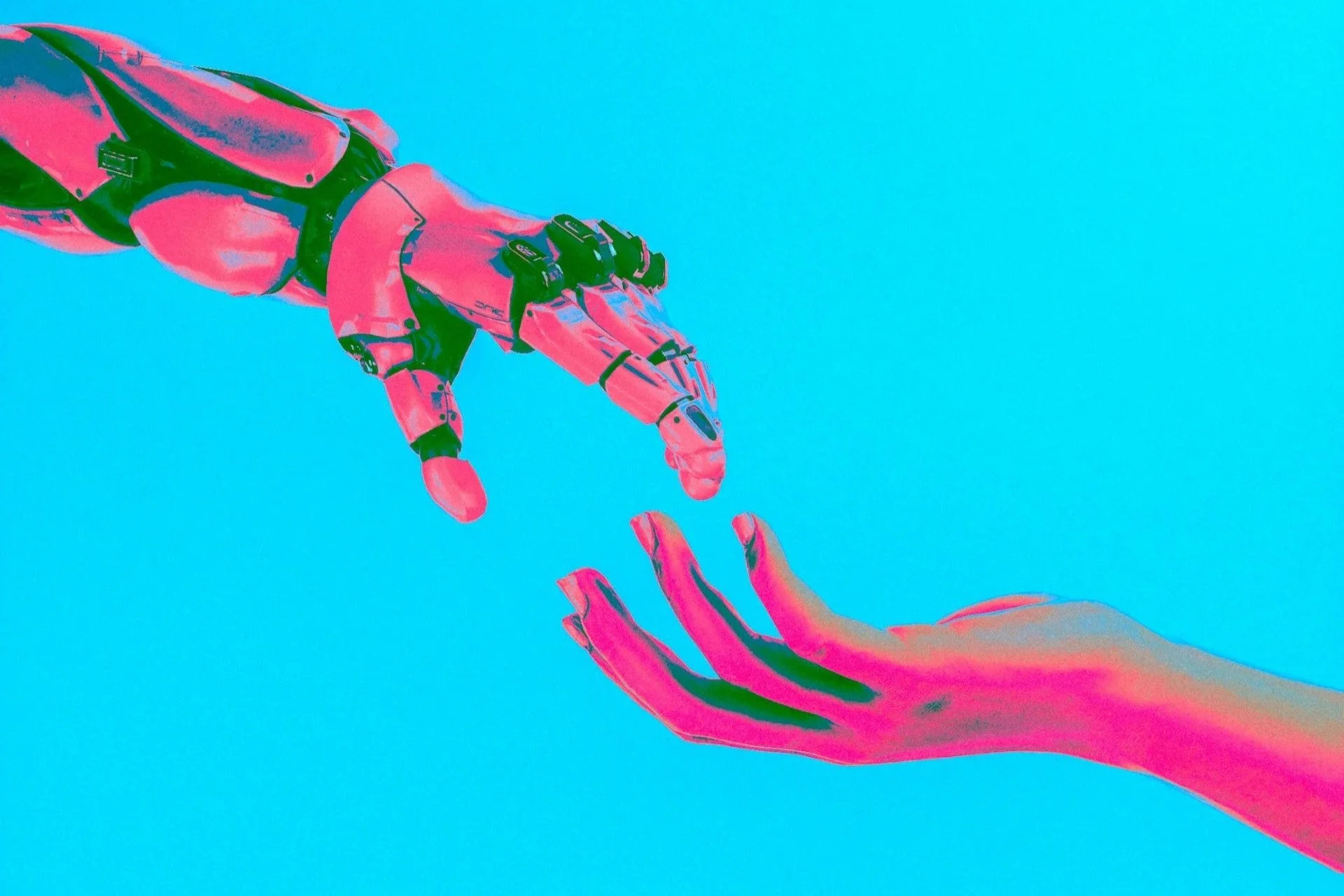
Why our greatest technological achievements cannot satisfy our deepest spiritual needs.
Imagine having a conversation with someone just twenty years ago and telling them what artificial intelligence would be capable of today. You might explain that computers would eventually write essays, diagnose diseases, translate languages, create realistic videos, develop software, and answer complicated questions in seconds. You might tell them that people would regularly have conversations with machines that appear remarkably intelligent. They would probably think you were describing science fiction. Yet here we are.
Artificial intelligence is rapidly changing how we work, communicate, learn, and understand the world. Some believe it will usher in an unprecedented period of human flourishing. Others fear it could become one of the greatest threats humanity has ever faced. What is particularly fascinating is that the people leading this technological revolution often express both extraordinary optimism and profound concern.
Sam Altman, CEO of OpenAI, wrote in his 2025 essay The Gentle Singularity, "We (the whole industry, not just OpenAI) are building a brain for the world." Meanwhile, Dario Amodei, CEO of Anthropic, wrote in his January 2026 essay The Adolescence of Technology, "Humanity is about to be handed almost unimaginable power."
These are remarkable statements. We are talking about creating systems capable of expanding human knowledge, multiplying human productivity, and perhaps accomplishing things previous generations could scarcely imagine. Yet beneath the excitement lies a question that technology itself cannot answer: Just because humanity can accomplish something, does that mean humanity possesses the wisdom to use it well?
The Bible has something surprisingly relevant to say about this question. In fact, one of the earliest stories in Scripture describes a civilization united around an ambitious technological project. Its people believed that through human ingenuity, cooperation, and innovation, they could secure their future and accomplish something extraordinary. That story is the Tower of Babel.
While Genesis 11 was not written about artificial intelligence, it reveals something timeless about the human heart. The danger is not simply what we are capable of building. The greater danger is what we begin to believe our buildings can do for us. And perhaps the greatest temptation of artificial intelligence is not that machines will become too much like humans, but that humans will continue trying to become like God.
The Tower of Babel: Humanity's Great Technological Ambition
The story of Babel appears in Genesis 11, shortly after the account of Noah and the flood. Humanity is beginning again. People are establishing communities, developing civilization, and discovering new possibilities through cooperation and innovation.
Genesis 11:3 describes an important technological development. The people begin manufacturing bricks and using tar for mortar. To modern readers, this might seem unremarkable. But in the ancient world, it represented an important advancement in construction. The people were developing more effective ways to build, and with this new technology came new possibilities.
They recognized that, working together, they could accomplish something extraordinary. Their vision was ambitious. Genesis 11:4 records their intention: "Come, let us build ourselves a city, with a tower that reaches to the heavens." They explain their motivation in the same verse: "so that we may make a name for ourselves; otherwise we will be scattered."
Notice what is happening. The problem is not that they discovered how to make bricks. Neither is the problem simply that they wanted to construct a city. Throughout Scripture, human creativity and craftsmanship are often presented positively. The problem is what they believed their creation would accomplish.
They wanted to make a name for themselves. They wanted to establish their greatness, guarantee their security, and determine their destiny apart from dependence upon God. Their desire to avoid being scattered also stood in tension with God's earlier command for humanity to fill the earth. The tower was more than an architectural project. It was a spiritual statement. In effect, the people were saying, "We can build our own significance. We can establish our own security. We can reach the heavens through our own accomplishments."
This is what makes Babel so relevant to our contemporary moment. The story is not fundamentally about ancient construction techniques. It is about the human tendency to turn good gifts into ultimate things. Technology becomes spiritually dangerous when we ask it to provide what only God can give. And that temptation has not disappeared. We have simply become much better at making bricks.
Technology Is a Good Gift but a Terrible God
Before drawing comparisons between Babel and artificial intelligence, we need to establish something important. The Bible is not opposed to technological advancement. In Genesis 1, God creates human beings in his image and gives them responsibility for cultivating and exercising stewardship over creation. Genesis 1:28 describes God's command for humanity to fill the earth and exercise dominion over the created world. Genesis 2:15 explains that God places Adam in the garden to work it and care for it.
Human beings were created to develop, cultivate, organize, and create. Our ability to invent new things is not necessarily evidence of rebellion against God. It can be an expression of our identity as his image-bearers.
Consider the blessings that have emerged through human innovation. Modern medicine has saved countless lives. Agricultural developments have helped feed growing populations. Communication technologies allow families separated by thousands of miles to remain connected. Christians should be grateful for these advancements.
Artificial intelligence may provide extraordinary opportunities to serve our neighbors. Imagine AI helping researchers discover treatments for devastating diseases. Imagine students receiving educational assistance previously unavailable to them. Imagine organizations becoming more effective in serving vulnerable communities. These are genuinely exciting possibilities.
In his October 2024 essay, Machines of Loving Grace, Amodei argued that "most people are underestimating just how radical the upside of AI could be." His optimism deserves serious consideration. Christians should not assume every technological advancement is inherently dangerous simply because it is unfamiliar.
Yet there is an important distinction between celebrating technological progress and placing our ultimate hope in it. Technology can improve our circumstances without transforming our hearts. It can give us more information without making us wise. It can increase our abilities without making us righteous. A society can become extraordinarily advanced while remaining spiritually impoverished.
This brings us back to Babel. The builders possessed remarkable technological abilities for their time. What they lacked was not intelligence. What they lacked was humility. They confused the ability to accomplish something with the authority to determine what was ultimately good.
The central problem at Babel was not human innovation. It was human innovation disconnected from submission to God. That distinction matters tremendously for how Christians think about artificial intelligence. We do not need to choose between rejecting technology altogether and embracing it without reservation. We can appreciate what technology makes possible while remaining deeply aware of the limitations of its creators.
A hammer can build a house or destroy something valuable. Its moral significance depends considerably on the purposes for which it is used. Artificial intelligence is far more complicated than a hammer, especially as increasingly autonomous systems introduce new questions of accountability and control. Nevertheless, the broader principle remains: our technological capabilities must be governed by moral wisdom. The Christian question is not simply, "Can we build it?" It is, "Should we build it, why are we building it, and whom will it serve?"
The Desire to Make a Name for Ourselves
One of the most revealing phrases in Genesis 11 is the people's desire to make a name for themselves. Why did they want this? Because human beings long for significance. We want our lives to matter. We want to accomplish something meaningful. We want to be remembered. We want assurance that our existence is not insignificant. These desires are not inherently wrong. The Bible teaches that human beings possess extraordinary dignity because we are created in God's image. The difficulty arises when we attempt to manufacture our significance through achievement.
We begin believing that our value depends on what we produce, accomplish, or control. And once our achievements become the foundation of our identity, we can never accomplish enough. Every success must be followed by another. Every advancement creates pressure for further advancement. Every breakthrough raises the question of what comes next.
We increasingly measure progress through speed, efficiency, productivity, and capability. Can we build a faster model? Can we automate another profession? Can we solve increasingly complex problems? Can we create systems more capable than the human beings who developed them? These questions are not necessarily wrong. But they become spiritually dangerous when technological achievement becomes the ultimate measure of human greatness.
In his 2024 essay, The Intelligence Age, Altman expressed his belief that AI could produce extraordinary prosperity and transform human life. There is something compelling about that vision. A world with less disease, greater opportunity, and fewer people living in poverty would be a wonderful thing.
But Christians must recognize an important difference between prosperity and salvation. Prosperity can improve the conditions of our lives. Salvation reconciles us to the God who gives life its meaning. One addresses what we have. The other addresses who we are and whose we are.
We can build sophisticated systems, accumulate extraordinary wealth, and enjoy unprecedented convenience while remaining profoundly uncertain about our worth. We can possess enormous power and still struggle with loneliness, envy, insecurity, and fear. Why? Because our deepest problem has never been a lack of technological capability. It has been our separation from God.
One of the most revealing features of the human heart is that we continually search for something outside ourselves to tell us that we matter. For some people, that something is career success. For others, it is wealth, appearance, relationships, or social recognition. For an entire civilization, it might be a technological achievement.
But whatever we make ultimate will eventually begin making demands of us. If success is our identity, failure becomes devastating. If productivity is our identity, rest becomes threatening. If recognition is our identity, obscurity becomes unbearable.
The gospel offers a radically different foundation for our identity. Rather than making a name for ourselves through our accomplishments, we receive our identity through what Christ has accomplished for us. Our worth is not something we manufacture. It is grounded in God's creative purpose and redeeming love. That truth frees us to pursue meaningful work without asking our work to justify our existence.
The Search for Security Without God
There is another revealing detail in the Babel narrative. The builders wanted to prevent themselves from being scattered across the earth. Their ambition was not driven merely by pride. It was also driven by fear. They wanted stability, protection, and control over an uncertain future. Their tower represented an attempt to secure their existence through their collective strength.
Doesn't that sound familiar? Much of modern technological advancement is motivated by humanity's desire to overcome vulnerability. We want to eliminate disease, predict disasters, prevent economic instability, and gain greater control over the forces that threaten our lives.
These desires frequently emerge from legitimate human needs. The Christian faith does not require us to accept preventable suffering without attempting to alleviate it. Jesus himself demonstrated extraordinary compassion toward the sick, hungry, and vulnerable. But Scripture also teaches that security becomes an idol when we look to created things for the ultimate assurance only God can provide.
Artificial intelligence exposes this temptation in a particularly interesting way. Some people hope AI will help humanity solve its greatest challenges. Others worry that the same technology could create threats we struggle to control. The very instrument we develop to increase our security can become another source of insecurity.
We build increasingly sophisticated systems to manage an unpredictable world, only to discover that those systems introduce new forms of unpredictability. AI can improve our ability to detect fraud, yet it can also enable new forms of deception. It can assist cybersecurity professionals while providing new tools for malicious actors. It can help people make informed decisions while also producing convincing misinformation. This is not an argument against developing AI. It is a reminder of human limitations.
Our intelligence is remarkable, but it is finite. Our motives are often mixed. Our institutions are imperfect. Even our greatest accomplishments remain vulnerable to unintended consequences.
The builders of Babel wanted complete security through human achievement. Yet Genesis 11 reminds us that human beings were never designed to live independently of their Creator. The Christian answer to our anxiety is not that we should abandon innovation. It is that we should stop expecting innovation to provide ultimate security.
There is a profound difference between wisely preparing for tomorrow and believing we can control tomorrow. Faith does not eliminate responsibility. It places our responsibilities within the larger reality of God's sovereignty.
When Human Intelligence Outpaces Human Wisdom
Perhaps the most unsettling aspect of the Babel narrative appears in Genesis 11:6. God acknowledges the extraordinary potential of unified human effort. The passage describes the possibilities emerging from the people's shared language and collective purpose. Yet God intervenes. Why? Not because creativity is evil or because knowledge threatens God's authority. God is not intimidated by human innovation. Rather, the narrative reveals the danger of concentrated human capability when it is organized around rebellion and self-exaltation.
Human beings can become extraordinarily effective at pursuing destructive purposes. This is a critical distinction for the age of artificial intelligence. Intelligence and wisdom are not the same thing. Intelligence concerns our ability to process information, recognize patterns, and solve problems. Wisdom concerns our ability to discern what is good, true, and worthy of pursuit. A person can be highly intelligent and profoundly unwise. A society can possess enormous scientific knowledge while lacking the moral character necessary to use it responsibly.
Artificial intelligence may magnify this problem because it can dramatically increase the speed and scale at which human intentions become actions. But greater capability does not automatically produce better intentions.
A powerful AI system might assist doctors in discovering new treatments. Similar capabilities could also be misused for manipulation, deception, or exploitation. AI might help someone learn more efficiently, but it might also enable someone to avoid the difficult intellectual work through which understanding and character develop.
The question is not simply whether AI works. The question is whether its use promotes genuine human flourishing. This requires more than technical expertise. It requires moral judgment, accountability, humility, and concern for others.
Amodei addresses this concern directly in The Adolescence of Technology. He compares humanity's current situation to a period of adolescence in which extraordinary power is developing faster than our demonstrated ability to manage it responsibly.
The analogy is striking. Adolescence is often characterized by increasing independence and expanding capabilities, yet maturity requires more than possessing the ability to act. It requires developing wisdom to exercise restraint. A teenager may finally possess the keys to a powerful vehicle, but having the keys does not automatically make that teenager a good driver. Likewise, humanity may soon possess tools of unprecedented capability without possessing a corresponding increase in moral maturity.
The book of Proverbs repeatedly presents wisdom as something rooted in reverence for God. Proverbs 9:10 begins, "The fear of the LORD is the beginning of wisdom." From a Christian perspective, the fear of the Lord is not irrational terror. It is the recognition that God, not humanity, possesses ultimate authority over what is good.
This means the most important questions surrounding artificial intelligence cannot be answered by engineers alone. They require thoughtful consideration from families, educators, policymakers, pastors, and the communities affected by these systems. Technical competence matters enormously. But no amount of processing power can relieve human beings of moral responsibility.
The people of Babel had enough knowledge to build their tower. What they lacked was the wisdom to recognize what their tower had become.
The Gospel: God Comes Down When Humanity Cannot Climb Up
If the story of Babel ended with humanity's failure, it would leave us with a rather discouraging conclusion. Human beings possess extraordinary potential, but our pride and insecurity repeatedly corrupt our achievements. Fortunately, Babel is not the end of the biblical story.
In fact, one of the most beautiful connections between Babel and the gospel appears in a seemingly insignificant detail. Genesis 11:5 begins, "But the LORD came down."
There is almost a sense of irony in the narrative. The people are constructing a tower intended to reach heaven. They believe they are building something astonishing. Yet the biblical author describes God as coming down to see it.
The tower that seemed so impressive from humanity's perspective was not nearly as impressive from heaven's perspective. Humanity cannot reach God through its own accomplishments.
And this is precisely where the gospel becomes such extraordinary news. The Christian message is not that God has given us better instructions for building a tower to heaven. It is that God himself has come down to us. John 1:14 declares, "The Word became flesh and made his dwelling among us." Think about the contrast.
At Babel, humanity attempts to ascend to heaven through collective achievement. In the incarnation, God descends from heaven in an act of astonishing humility. At Babel, people seek to make their own name great. Jesus comes to glorify his Father and give himself for others. At Babel, human beings pursue power and security. Jesus voluntarily embraces weakness and suffering. At Babel, people attempt to secure their future through what they build. At the cross, Jesus secures the salvation of his people through what he sacrifices.
Philippians 2:6-8 describes Christ's humility. Although Jesus was truly God, he did not exploit his divine status for selfish advantage. Instead, he became a servant and willingly endured death on a cross. This is the very opposite of Babel.
The builders wanted to elevate themselves. Jesus humbled himself. They sought greatness through power. Jesus revealed divine greatness through sacrificial love. They wanted to establish a name that would endure. Jesus received the name above every name through his obedient, self-giving work.
And why did Jesus do this? Because our problem is deeper than misplaced technological confidence. Scripture teaches that we have all turned away from God. We have attempted to live as though we possess ultimate authority over our lives. We have sought meaning in accomplishments, security in possessions, and identity in the approval of others. In countless ways, we have constructed our own towers. And none of them can reconcile us to God. That is why Jesus came.
He lived the life of perfect obedience that we have failed to live. He died on the cross, bearing the judgment our sins deserve. And he rose from the dead, defeating sin and death and opening the way to everlasting life.
The gospel is not a message about humanity finally becoming impressive enough for God to accept us. It is the announcement that God has graciously accomplished what we could never accomplish for ourselves.
Ephesians 2:8-9 begins, "For it is by grace you have been saved, through faith." Salvation is God's gift, not a reward for human achievement. This is wonderfully liberating. We do not need to build something extraordinary to earn God's love. We do not need to become more intelligent, productive, wealthy, or successful to secure our place in His family. We are invited to turn from our sin, trust in Jesus Christ, and receive what he has already accomplished.
And because our identity is secure in him, we are finally free to use our abilities without worshiping them. We can build without needing our buildings to save us. We can create without needing our creations to define us. We can pursue progress without placing our ultimate hope in progress.
From Babel to Pentecost: A Different Kind of Unity
There is another fascinating biblical connection worth considering. At Babel, humanity's rebellious unity results in the confusion of languages and the scattering of people. But in Acts 2, something remarkable happens.
Following Jesus' resurrection and ascension, the Holy Spirit is poured out upon the disciples at Pentecost. People from many different nations gather in Jerusalem, and suddenly they begin hearing the followers of Jesus proclaiming God's mighty works in their own languages.
Acts 2:6 explains that "each one heard their own language being spoken." There is a striking contrast with Babel. But notice that Pentecost does not simply erase linguistic diversity. God does not require everyone to adopt one human language. Instead, through the Spirit, people from different backgrounds are enabled to understand the same good news.
Unity emerges not through humanity's attempt to achieve greatness, but through God's gracious action. This is significant for our technological age. Artificial intelligence may eventually make communication between languages easier than ever before. That could be a tremendous gift. But even perfect translation would not automatically produce genuine human unity.
After all, people who speak the same language still misunderstand, manipulate, and harm one another. Our deepest divisions are not merely linguistic. They are spiritual and relational. What we ultimately need is not simply better communication. We need reconciliation.
And the gospel provides that reconciliation through Jesus Christ. Ephesians 2 describes how Christ breaks down hostility and creates one new humanity through his death.
The church is intended to be a living demonstration of this reality. People who might otherwise remain divided by differences in background, economic status, ethnicity, and personal history are brought together through a shared Savior.
At Babel, human beings sought unity through their collective power. At Pentecost, God created unity through his Spirit. At Babel, people wanted to make a name for themselves. At Pentecost, believers proclaimed the name of Jesus. And that name remains the foundation of the church's hope.
How Should Christians Respond to Artificial Intelligence?
So, what does all of this mean for Christians living in an increasingly technological world? The answer is neither fear nor blind enthusiasm. It is a faithful stewardship.
Christians should approach artificial intelligence with gratitude for its possibilities, discernment concerning its dangers, and humility about its limitations. We should ask whether the ways we use AI help us love God and our neighbors more faithfully.
For example, AI might help a busy parent organize a family schedule, assist someone learning a new language, or help a church communicate more effectively with its congregation. These can be appropriate and beneficial uses of technology. But we should also recognize that convenience is not always the same as goodness.
A person might use AI to write a thoughtful message to a struggling friend. Yet if the technology consistently replaces the personal attention, prayer, and emotional investment that meaningful relationships require, something important may be lost.
Similarly, AI can summarize Scripture, explain theological concepts, and assist with biblical research. Yet it cannot replace the spiritual formation that occurs when someone patiently reads God's Word, wrestles with its meaning, and responds in prayer and obedience.
There is a difference between obtaining information about God and cultivating a relationship with God. And the church must never confuse the two.
We should also remember that human beings possess a dignity that cannot be reduced to intelligence or productivity. Our value comes from being created in God's image, not from how effectively we process information.
This means the elderly person experiencing cognitive decline, the child with developmental disabilities, and the worker whose job may be displaced by automation possess the same fundamental human dignity as the world's most accomplished scientist.
That conviction should shape how Christians participate in conversations about AI, employment, education, and economic opportunity. Technology should serve human beings, not reduce human beings to instruments of technological progress.
For parents, this also means helping children learn that not every answer needs to be immediate, and not every difficulty needs to be removed. Patience, perseverance, thoughtful reflection, and genuine relationships are essential components of character formation.
A child who can obtain every answer instantly may still need to learn how to ask good questions. A student who can produce an essay in seconds may still need to learn how to think carefully. And a Christian who can generate a prayer through artificial intelligence still needs to cultivate the habit of personally turning toward God. Our tools should strengthen the practices that make us more fully human rather than gradually replacing them.
For churches like Orchard Hill, this presents both an opportunity and a responsibility. We can thoughtfully embrace tools that help us serve people, communicate the gospel, and carry out ministry more effectively. But we must never lose sight of what makes the church the church.
The church is not primarily a content-production organization. It is not simply a gathering of people who share religious information. It is the community of God's redeemed people, brought together by Jesus Christ and empowered by the Holy Spirit.
No algorithm can replace the presence of a friend sitting beside someone in grief. No automated system can substitute for the embodied companionship of believers gathered around God's Word. No technological breakthrough can accomplish the forgiveness of sins or the transformation of the human heart. These realities remind us that efficiency is not the highest good. Faithfulness is.
The Tower We No Longer Need to Build
The story of Babel confronts us with an uncomfortable truth. Human beings have an extraordinary capacity to create, but we also have a persistent tendency to seek ultimate meaning in the things we create.
Our towers change from generation to generation. Sometimes they are architectural wonders. Sometimes they are political empires, financial institutions, or scientific achievements. Today, they may include systems of artificial intelligence that promise to transform nearly every dimension of human life.
But beneath changing technology, the human heart remains remarkably consistent. We still want to make a name for ourselves. We still want to secure our future. We still want to overcome our limitations. And we are still tempted to believe that one more breakthrough might finally deliver the fulfillment we have been seeking. Yet Christianity announces something profoundly different.
The most important event in human history was not humanity's ascent toward greater power. It was God's descent toward us in Jesus Christ. The greatest demonstration of wisdom was not a technological discovery. It was the seemingly foolish message of a crucified Savior. The greatest victory was not humanity conquering its limitations. It was Jesus, conquering sin and death through His resurrection. And the greatest hope for our future is not that human beings will eventually become powerful enough to save themselves. It is that the risen Christ will return to make all things new.
This does not make technological progress irrelevant. It puts technological progress in its proper place. We should pursue discoveries that alleviate suffering. We should develop tools that serve our neighbors. We should celebrate genuine advances in knowledge, medicine, education, and human flourishing.
But we should never confuse those achievements with the redemption of the world. Only Jesus can accomplish that.
The people of Babel believed they needed to build a tower that reached heaven. The gospel tells us that heaven has already come down. They wanted to make a name for themselves. In Christ, we are given a new name and a secure identity as children of God. They wanted to guarantee their future. In Christ, we receive a future grounded not in human achievement but in God's unfailing promises.
And perhaps this is the most important truth Christians can offer an anxious and ambitious technological world. Our ultimate hope is not found in what humanity can create. Our ultimate hope is found in the Creator who entered his creation to redeem it.
Artificial intelligence may change our world in extraordinary ways. It may help solve problems we once considered impossible. It may introduce new challenges that require unprecedented wisdom and cooperation.
But no matter how intelligent our machines become, the deepest needs of the human heart will remain the same. We will still need forgiveness. We will still need meaning. We will still need love. We will still need hope. And we will still need Jesus. Because in the end, the answer to Babel was never a taller tower. It wasa Savior.